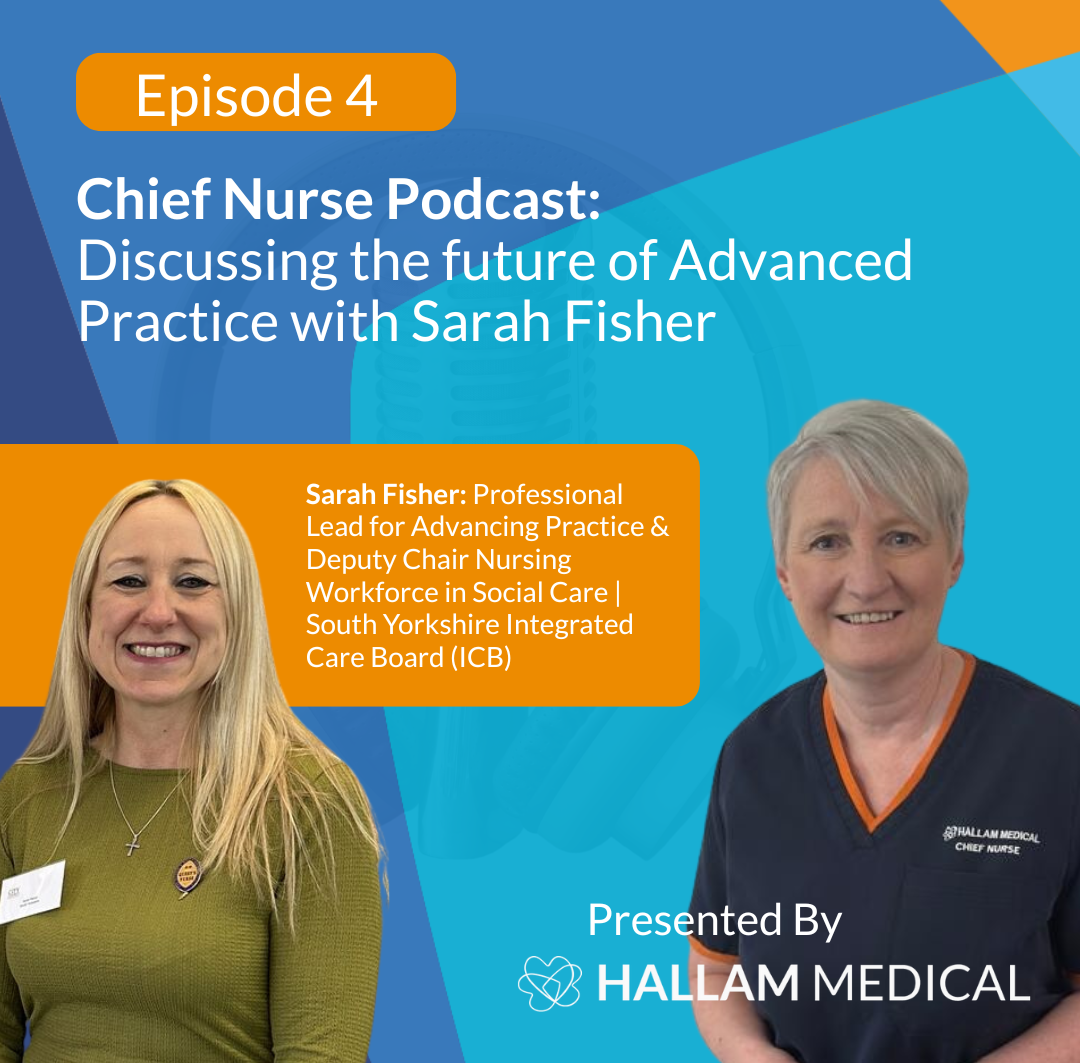
Discussing the Future of Advanced Practice: A Q&A with Sarah Fisher
In a recent episode of the Hallam Medical Chief Nurse Podcast, Lisa Locker speaks with Sarah Fisher, Professional Lead for Advancing Practice and Deputy Nurse for the Social Care Nursing Workforce at South Yorkshire Integrated Care Board (ICB).
Together, they explore the history of advanced practice in South Yorkshire, discuss what the future holds for the advanced practice workforce, reflect on the NHS 10-Year Plan, and highlight the support available to advanced practice colleagues across the region.
Read on to discover key insights from their Q&A conversation.
Q: Sarah, can you introduce yourself and tell us about your background?
I’m Sarah Fisher and I’m the Professional Lead for Advancing Practice and Deputy Nurse for the Social Care Nursing Workforce at South Yorkshire ICB.
I’ve been a nurse for over 25 years and an Advanced Clinical Practitioner for around 18–19 of those years. Most of my clinical background is in primary care, GP practice, urgent care centres, walk-in centres and emergency departments. That variety of experience has been important in shaping how I now support and develop the advanced practice workforce across South Yorkshire.
Q: How did advanced practice develop in South Yorkshire?
South Yorkshire has been fortunate to have a strong and forward-thinking history in advanced practice. Around 2015, Julie Perrin, a Nurse Consultant at Sheffield Teaching Hospitals, and Dr Simon Clarke, a Consultant Neonatologist, set up the South Yorkshire Faculty of Advanced Practice.
With funding from Health Education England, this became the first local faculty of its kind in England. From the beginning, the focus was on supporting the workforce properly and improving access to timely, high-quality care for patients.
Q: What challenges were identified early on?
Advanced practice developed much earlier in hospital settings, which meant colleagues in primary care, community services and mental health often struggled. Accessing training, completing master’s programmes and getting appropriate supervision was much harder outside acute settings.
There was also confusion around titles, nurse practitioner, minor illness nurse, advanced practitioner, which didn’t always reflect the complexity of the work being done.
Q: How was this addressed?
The faculty introduced additional support, including: GP-led education sessions, enhanced paediatric training, clinical supervision, and portfolio support to evidence competence. This helped practitioners feel safer, more confident and better supported, which ultimately improves patient care.
Q: What role do you play now within the ICB?
I initially joined as the Primary Care Lead five years ago and later took over as Professional Lead. We were fortunate in South Yorkshire to already have a strong team in place when ICBs were formed.
We’ve expanded support to all advanced practitioners, regardless of clinical setting, and we’re now embedded within the ICB. That means we have a direct voice to the Chief Nurse Executive and Medical Director, which is incredibly important for advocating for advanced practice.
Q: What support is available for advanced practitioners in South Yorkshire?
We’ve built a real community of practice, so people know where to go for advice and support. We offer: online education sessions, network events, clinical supervision, one-to-one support and pastoral support.
We also have a website where education resources can be accessed for free, and I’m always happy to be contacted directly. Supporting the workforce isn’t just about competence, it’s about confidence and wellbeing too.
Q: What does the future look like for advanced practice?
In one word: opportunity. Advanced practice is now clearly recognised in the NHS 10-Year Health Plan, which is hugely positive.
We’re a skilled, valuable workforce, and the care we provide has a real impact. Advanced practitioners are working not just in NHS services, but in prisons, hospices and increasingly in social care. We need to think beyond organisational boundaries and recognise that we are effectively one workforce.
Q: Can you tell us about the care home pilot in South Yorkshire?
This is something I’m passionate about. We’ve started a 12-month pilot placing an Advanced Practitioner directly into a nursing home.
The idea came from my own clinical experience and from my master’s dissertation, which showed that having an embedded advanced practitioner improves outcomes, reduces 999 calls, supports deprescribing and provides truly personalised care. Within the first week, we saw reduced GP contact and improved care for residents. The pilot runs until December 2026, when we’ll fully evaluate it with the aim of scaling it up.
Q: Why is this model so important?
Care home residents don’t need to go into hospital to receive high-quality care. Having an advanced practitioner who knows residents well, just like family, means we can spot deterioration early and act quickly.
It also reduces pressure on primary care and acute services and creates meaningful career development opportunities for nurses and other professionals working in social care.
Q: How important is multi-professional advanced practice?
It’s absolutely vital. While many advanced practitioners are nurses, we also have paramedics, physiotherapists, pharmacists and others working at this level. We all bring different perspectives and expertise, and patients benefit enormously from that. There’s also a big piece of work needed to help the public understand the breadth of advanced practice roles.
Q: What role do professional networks play?
Networks are incredibly powerful. The Queen’s Institute of Community Nursing (QICN), for example, allows us to connect, influence policy and raise issues at senior levels. This care home pilot actually came about through relationships built via QICN. It shows how networking and leadership can directly improve patient care.
Q: What message would you leave for advanced practitioners?
Advanced practice makes a real difference. Hearing a patient say, “If it weren’t for you, I wouldn’t have had my diagnosis,” makes all the hard work worthwhile.
We should continue to celebrate advanced practice, support each other and keep pushing for innovation, because the future really is positive.