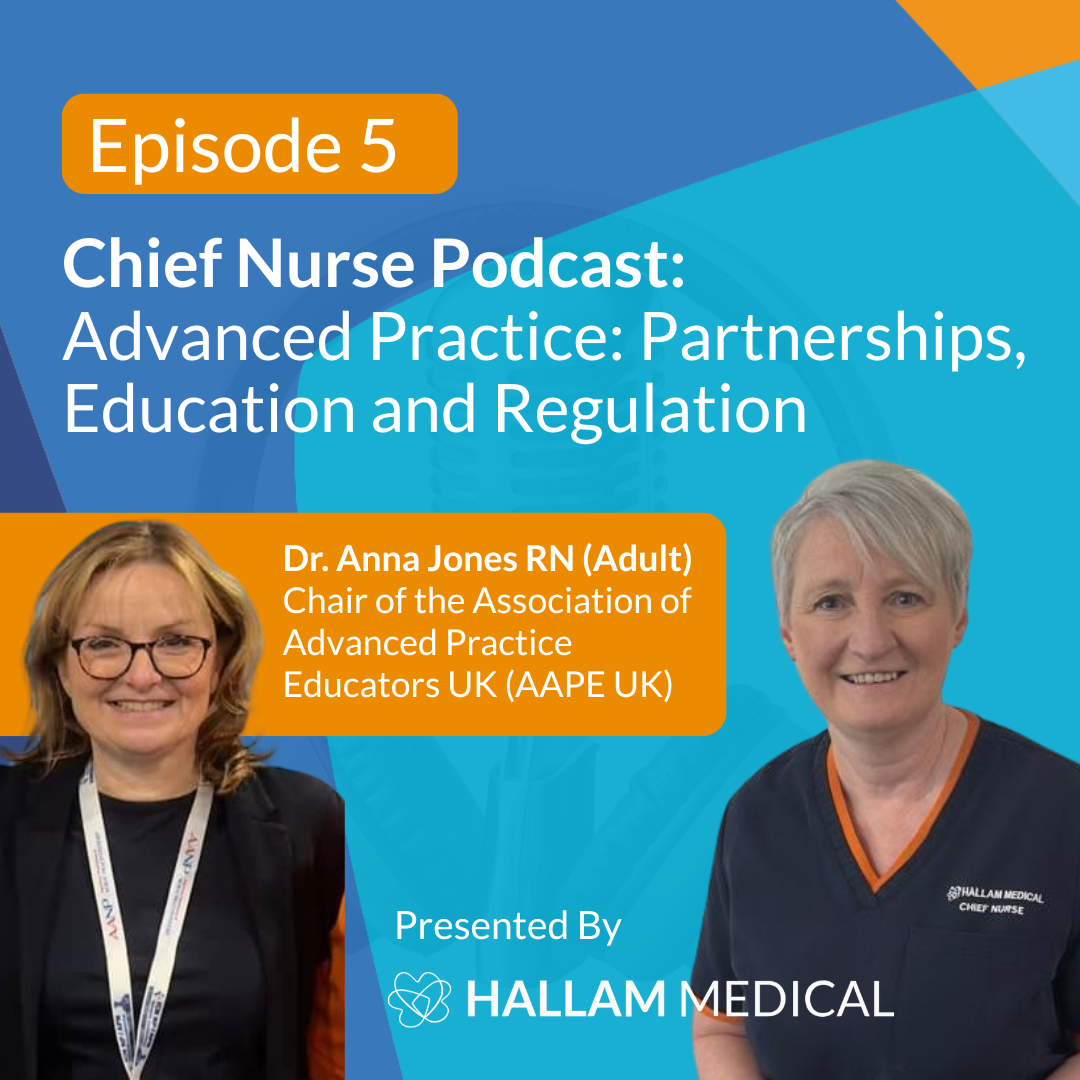
Advanced Practice – Partnerships, Education and Regulation: Q&A with Anna Jones
In a recent podcast episode, our Chief Nurse, Lisa Locker, sat down with Dr Anna Jones, Chair of the Association of Advanced Practice Educators UK (AAPE), to explore the evolving landscape of Advanced Practice in the UK.
Together, they discussed the importance of partnership working, how universities design Advanced Practice programmes, and why regulation and national principles are essential for patients, professionals, and the future of the role.
Read on to discover the key insights from their Q&A conversation
Q: Anna, can you tell us a bit about yourself and your role?
I’m Anna Jones, I am the Chair of the Association of Advanced Practice Educators UK and a member of the Wales Advanced Practice Educator Network. I’ve worked in higher education for over 20 years, focusing on advanced practice.
My clinical background is in critical and coronary care nursing within the NHS, and I completed my PhD in 2019. I also contributed to the NMC Advanced Practice Review as the Wales representative. Currently, I’m Programme Manager for the MSc in Advanced Healthcare Practice at Cardiff University and I’m currently in the School of Healthcare Sciences at Cardiff University, the Programme Manager for the MSC in Advanced Healthcare Practice.
I am also involved in several projects of involving advanced practice rights across the UK and globally, collaborating with colleagues right across the globe.
Q: What impact has the partnership between AAPE and Hallam Medical had?
Quite simply, AAPE wouldn’t be where it is today without Hallam Medical. Your support has enabled us to deliver education and conferences to over 90 institutions across the UK and enable us to reach out to our members and offer that education input for free, which has been an absolute phenomenal and fantastic resource.
So, we are completely grateful to Hallam Medical for that support and for the amazing relationship that we have in terms of it’s a two-way relationship I think in that we support you and you support us.
Q: What factors are considered when developing an advanced practice curriculum?
A very good question, Lisa, and the answer is vast. But we do have to consider all or any PSRB sort of professional and statutory body requirements, which may include, for example, the up-and-coming NMC regulation of advanced practice.
So, we would need to look at whatever standards of education that might be involved in that any proficiencies in practice that we would need to incorporate, but we also benchmark and map against other requirements and other professional bodies, work and standards and capabilities.
Collaboration and Co production is key because we cannot develop programs without knowing what we need to fix. And having alumni on board and having student feedback is absolutely crucial and also having patient and public involvement feedback too.
Q: Why do you think the regulation of advanced practice so important to patients and the public?
It’s patient safety. Ultimately, we’re protecting the public and that’s what nursing and midwifery are all about and healthcare in general. We need to ensure that there is that public safety and currently we don’t know how many advanced practitioners there are out there.
We can guess that there are about 40,000, possibly 50,000 across the UK, but that doesn’t give us a definitive number. And what we hear is that there are individuals who are practising within scope within advanced practice but don’t have the title or there are individuals who practice outside scope and have the title.
It is a very challenging landscape at the moment because we just don’t know and therefore because the NMC don’t know, they don’t have a register of who the advanced practitioners are.
Q: Is there still confusion about advanced practice roles?
Yes, both among the public and within healthcare.
Patients often assume they’re seeing a doctor, and even professionals may not fully understand the scope of advanced practice. Clear communication and education are key to addressing this.
The NMC Advanced Practice Regulation Group has devised two different definitions, one for us as professionals and one that is lay person led that is for the public specifically, to give the public some understanding and appreciation of what advanced practice is.
Q: Are the new advanced practice principles enough to provide clarity to the public?
They’re a very good start.
I’m very proud to have been part of that work and particularly I think the clarity that it’s brought for employers and in terms of early adoption of those principles. They’re not the regulation, but they are a good precursor to enable people to begin to understand what it’s about and how it’s going to impact them eventually in 2029, with the work starting next year in 2027 on getting the educational standards written and the proficiencies written.
You can listen to the full podcast here: https://hallammedical.com/podcast/